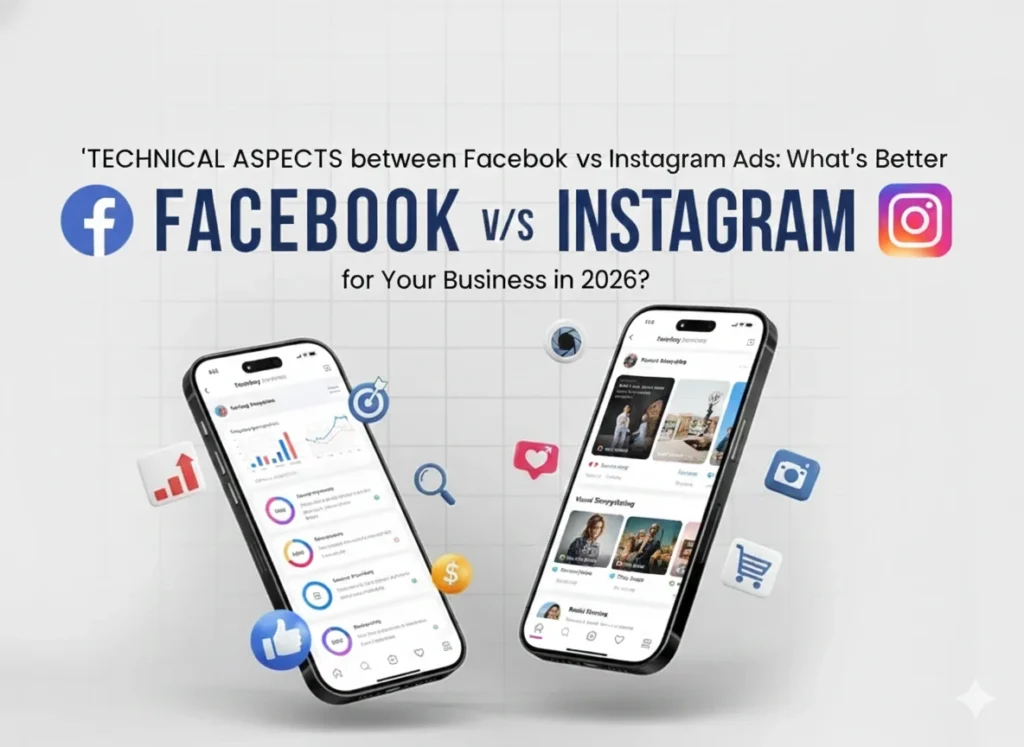
Running ads on social media has become one of the most effective ways for businesses to reach customers, but choosing the right platform is what determines whether your budget produces real results or gets wasted. In 2026, two platforms continue to dominate paid advertising under Meta’s ecosystem: Facebook Ads and Instagram Ads. Both use the same Ads Manager, share similar targeting options, and allow brands to promote content across large audiences. But technically, they are not the same.
Facebook offers a wide range of ad placements, flexible formats, detailed targeting, and cost-efficient conversion options. Instagram, on the other hand, is built around visual-first content, higher engagement rates, and a younger, mobile-active user base. For businesses, the challenge is no longer “Which platform is more popular?”, it’s “Which one delivers the best performance for my goals, audience, and creative assets in 2026?”
This blog breaks down the technical differences between Facebook and Instagram Ads, including audience behaviour, ad formats, cost performance, creative requirements, and 2026 trends. By the end, you’ll have a clear picture of which platform is better suited for your business and how to make a data-driven choice that maximises ROI.
Overview: Shared Infrastructure, Meta Ads Manager & Targeting Engine
One of the biggest strengths (and sometimes confusing parts) of advertising on Facebook and Instagram is that, at the technical level, they don’t really operate as fully separate ad systems. Instead, both platforms tap into the same backend infrastructure: Meta Ads Manager handles campaign creation, targeting, budget controls, placement decisions, and reporting for both.
What this means in practice
- Single dashboard for all ads. Whether you want to run a Facebook‑only campaign, an Instagram‑only campaign, or a combined campaign, you manage everything inside Meta Ads Manager. You don’t need separate “ad accounts” for each platform.
- Unified targeting & audience tools. Demographics, interests, behaviours, custom audiences, lookalike audiences, all these targeting options are common across both Facebook and Instagram when you set up campaigns. That means you can build one audience definition and apply it across platform placements.
- Flexible placement control. When creating a campaign, you can choose where your ads run: only on Facebook, only on Instagram, or on both. If you activate “automatic placements,” Meta’s algorithms will decide where your ads are most likely to perform well (across Facebook, Instagram, and other Meta networks).
- Shared reporting & analytics. Because it’s the same system under the hood, you get consolidated data across placements impressions, clicks, conversions, cost, return on ad spend (ROAS), etc. This helps you compare performance between platforms (Facebook vs Instagram) using a consistent metric set.
What that Infrastructure Advantage Offers Businesses
Using a unified ad infrastructure provides several real advantages for marketers and business owners:
- Efficiency and simplicity: No need to learn or manage two completely different tools. Whether you run ads on Facebook, Instagram, or both it’s all managed from the same place.
- Easy cross-platform testing & scaling: Because you can run campaigns across both platforms with shared audience definitions and budgets, it’s straightforward to test which platform works better for your business, and scale what performs best.
- Consistent targeting & retargeting: Shared audiences make retargeting and lookalike/expansion strategies more seamless, visitors who interacted on Instagram can be retargeted via Facebook (or vice versa) without complex setup.
- Unified measurement & optimization: You can compare performance across platforms fairly (same conversion events, same tracking, same data), which helps data-driven decisions and optimization.
Audience & Demographics, Who You’re Reaching (Technical & Strategic Relevance)
Understanding the audience on each platform is one of the most important technical aspects when choosing between Facebook and Instagram ads in 2026. Even though both platforms share Meta’s ad infrastructure, the users themselves and how they interact with content are different, which directly affects ad performance and engagement.
Facebook Audience
- Broader age range: Facebook attracts users across almost every age group, from younger adults to seniors. While younger users are slightly declining, the platform still has strong reach among 30–65+ age groups.
- Diverse interests and behaviours: Users engage with a wide variety of content types, news, groups, events, shopping, and community updates. This makes Facebook suitable for businesses targeting diverse demographics or B2B audiences.
- Engagement patterns: Facebook users tend to spend more time reading content, clicking links, or engaging with groups and communities, rather than reacting primarily to visuals.
Instagram Audience
- Younger, mobile-first users: Instagram continues to be popular among Gen Z and millennials. Most users access the platform via mobile, making it ideal for mobile-optimized content like short-form videos, Stories, and Reels.
- Visual-first engagement: Instagram users engage more with images, videos, and interactive media (polls, stickers, carousel ads). Brands that rely heavily on visual storytelling tend to perform better here.
- Impulse-driven behaviour: Users on Instagram are more likely to act on lifestyle inspiration, trends, and social recommendations, which can lead to higher engagement and purchase intent in certain niches.
What This Means for Businesses
- Choose based on your target audience:
- Products or services appealing to younger, trend-focused audiences are more likely to perform well on Instagram.
- Services aimed at broader or older demographics, professional audiences, or information-heavy offers may see better results on Facebook.
- Consider content style: Even with the same audience, the ad format and creative style should match user behaviour, visual and snackable content for Instagram, informative or link-driven content for Facebook.
- Testing is essential: Use small-scale campaigns on both platforms to compare performance. Metrics like CTR, engagement rate, and conversion rate will tell you which platform resonates more with your audience.
Ad Formats & Creative Flexibility, What Types of Ads Each Platform Supports
When deciding between Facebook and Instagram Ads in 2026, understanding ad formats and creative flexibility is critical. Although both platforms share the same backend through Meta Ads Manager, they differ significantly in how content is displayed and how users engage with it. Choosing the right ad format for your business goals can have a direct impact on engagement, conversions, and ROI.
Facebook Ad Formats
Facebook offers a wide range of ad types that support different business objectives:
- Image Ads: Simple single-image ads that are effective for brand awareness or product promotion.
- Video Ads: Supports longer videos, ideal for storytelling, tutorials, or detailed product demonstrations.
- Carousel Ads: Allows multiple images or videos in a single ad, great for showcasing a range of products or services.
- Collection Ads: Combines videos/images with product catalogs, designed for shopping-focused campaigns.
- Lead Ads: Collect user information directly within Facebook, suitable for B2B or service-based businesses.
- Link Ads: Drive traffic to your website, blog, or landing pages.
Technical Implication: Facebook’s variety of formats makes it suitable for campaigns requiring detailed messaging, link clicks, or multi-step conversions. Businesses can mix ad types to target different stages of the marketing funnel.
Instagram Ad Formats
Instagram is visually driven, with ad formats built for engagement and mobile-first consumption:
- Photo Ads: High-quality images optimized for storytelling or product showcases.
- Video Ads: Short-form videos for Reels, Stories, or feed placements. Instagram prioritizes attention-grabbing, snackable videos.
- Carousel Ads: Multiple visuals in one ad, perfect for lifestyle brands or product ranges.
- Stories Ads: Full-screen vertical ads between user Stories, highly immersive and interactive.
- Reels Ads: Short-form vertical videos designed for entertainment and high engagement.
- Shopping/Taggable Ads: Users can tap products in ads to view or purchase directly.
Technical Implication: Instagram requires high-quality visuals and content optimized for quick consumption. Ads that don’t match the platform’s aesthetic standards may underperform or lead to higher ad costs.
Choosing the Right Platform Based on Creative Needs
- For visually driven, lifestyle, or impulse-based products: Instagram is the better choice. Formats like Reels, Stories, and Shopping Ads are built to capture attention and drive action quickly.
- For information-heavy, multi-step campaigns or link-based objectives: Facebook’s flexibility with longer videos, link ads, and lead forms is advantageous.
- Cross-platform campaigns: Businesses can leverage both platforms simultaneously using Meta Ads Manager, testing creative performance across different ad formats to see what resonates best with each audience.
Performance Metrics: Cost (CPC, CPM), Engagement, Conversions, What 2025–2026 Data Suggests
When comparing Facebook and Instagram Ads, understanding performance metrics is crucial for making a data-driven decision. Metrics like cost per click (CPC), cost per thousand impressions (CPM), engagement rates, and conversions reveal how efficiently your ad spend translates into results.
Cost Metrics: CPC and CPM
- CPC (Cost Per Click): Measures how much you pay each time a user clicks on your ad.
- Instagram generally has higher CPC due to its younger, highly engaged audience and competitive ad space.
- Facebook often delivers lower CPC, especially for campaigns targeting broader or older demographics.
- CPM (Cost Per Thousand Impressions): Shows the cost to reach 1,000 users.
- Instagram tends to have higher CPM because visually engaging content attracts more competition.
- Facebook’s CPM can be more cost-effective, particularly for campaigns aimed at conversions or link clicks.
Engagement Metrics
- Instagram: Typically has higher engagement rates due to its visual-first, interactive content. Users are more likely to like, comment, share, or view Reels and Stories.
- Facebook: Engagement is lower than Instagram on average, but users often interact with posts in meaningful ways, such as clicking links, joining groups, or completing lead forms.
Conversion Metrics
- Facebook: Often performs better for lead generation, website traffic, and multi-step conversions. Its diverse ad formats support campaigns with specific conversion goals.
- Instagram: Best suited for impulse purchases, brand awareness, and direct-response campaigns tied to visual products (like fashion, lifestyle, or e-commerce items).
What the Data Tells Us
- Businesses should measure multiple metrics to see which platform is performing better for their specific goals.
- A/B testing ads on both platforms using the same creative and targeting allows you to compare CPC, CPM, CTR (click-through rate), and conversions.
- Even if Instagram drives more engagement, Facebook may still deliver more cost-effective conversions depending on your campaign objective.
Use-Case Based Recommendations, Which Platform for What Type of Business / Goal
| Platform | Key Challenges / Drawbacks | Impact on Business / Campaigns |
| Higher competition for ad space | Can increase CPC and CPM, especially in lifestyle or visual niches | |
| Heavy reliance on high-quality visuals | Poor-quality images or videos can reduce engagement and ad performance | |
| Shorter attention span of users | Ads must be attention-grabbing and mobile-optimized; longer messages may underperform | |
| Limited link-driven ad options | Driving traffic to websites or landing pages is less effective than on Facebook | |
| Lower engagement rates among younger users | Visual, impulse-driven campaigns may perform less effectively | |
| Audience skewing older | Brands targeting Gen Z or trend-driven audiences may not reach them as efficiently | |
| Ad fatigue in highly competitive markets | Requires frequent creative updates to maintain performance | |
| Multi-step conversion campaigns may require more optimization | Lead generation or website conversions need careful monitoring and testing |
Technical & Strategic Challenges / Drawbacks to Consider
On Instagram: higher competition and cost (especially in visual / lifestyle niches), which can increase ad spend.
Visual dependency: if your brand doesn’t have strong visual assets (photos, videos), Instagram may underperform.
On Facebook: content may need to be more text- or link-heavy; may not appeal to younger demographics as much.
Ad fatigue / audience saturation: because of broad reach & many advertisers, need careful targeting & ad rotation.
2026 Trends & What to Watch (Predicted / Emerging)
As we move into 2026, both Facebook and Instagram are evolving rapidly. Understanding emerging trends can help your business stay ahead and make smarter ad decisions.
| Trend | Implications for Businesses | ||
| Short-form video dominance | Reels and Stories continue to grow in popularity | Facebook also supports video, but feed videos get less engagement than Instagram Reels | Businesses should create mobile-optimized, visually engaging short-form videos to capture attention |
| Cross-platform campaigns | Ads can run simultaneously on Instagram and Facebook | Same backend for cross-platform optimization | Use Meta Ads Manager to test campaigns, scale what works, and reach multiple audience segments efficiently |
| Enhanced targeting & retargeting | Custom and lookalike audiences increasingly refined | Similar targeting options; behavior-based targeting continues to improve | Leverage data-driven targeting to reduce wasted spend and increase conversions |
| Creative quality matters more than ever | Users expect highly engaging visuals | Ads with poor visuals may underperform | Invest in professional visuals, video, and interactive content to maintain engagement |
| Mobile-first focus | Instagram is mobile-native | Facebook also mobile-optimized, but desktop still relevant | Ensure ads are optimized for vertical mobile formats and fast loading |
| Shopping and e-commerce integration | In-app shopping continues to expand | Facebook Shops growing but Instagram shopping often higher engagement | E-commerce brands should leverage product tags and shoppable ads, especially on Instagram |
Decision Framework: How to Choose Between Facebook & Instagram Ads for Your Business in 2026
Choosing the right platform for your social media advertising doesn’t have to be complicated. Start by clearly defining your business objectives: are you focusing on brand awareness, engagement, website traffic, or direct conversions?
Instagram is generally better suited for campaigns aimed at building brand visibility and engagement, particularly among younger audiences, while Facebook is often more effective for driving conversions and lead generation. Understanding your target audience is equally critical.
Younger, visually-oriented users tend to engage more on Instagram, whereas Facebook offers broader demographic reach, including older and professional audiences.
Next, evaluate your creative assets. Instagram demands high-quality visuals and short-form videos optimized for mobile, while Facebook accommodates text-rich, information-heavy ads and longer video content.
Budget considerations also play a role Instagram typically has higher cost-per-click and cost-per-thousand impressions due to competition, while Facebook can be more cost-efficient for campaigns with specific conversion goals.
Finally, consider the nature of your business: visual and lifestyle products perform well on Instagram, whereas professional services, B2B solutions, and multi-step conversions often find Facebook more effective.
Regardless of platform choice, testing small campaigns on both platforms and analyzing performance metrics such as CPC, CTR, and conversions will help you make data-driven decisions and optimize your ad spend.
Conclusion & Recommendation
Both Facebook and Instagram Ads remain powerful tools for businesses in 2026, but the “better” platform depends on your specific goals, audience, creative assets, and budget. Instagram excels for visually driven campaigns, lifestyle or e-commerce products, and reaching younger, mobile-first audiences.
While engagement is generally higher on Instagram, this comes at a higher cost, making creative quality crucial. Facebook, on the other hand, offers flexibility for text-heavy, link-driven campaigns, broader demographic reach, and cost-effective conversions, making it a strong choice for lead generation and professional services.
For many businesses, the most effective approach is a combined, cross-platform strategy. Using Meta Ads Manager, you can run campaigns across both Facebook and Instagram, test performance, and optimize budgets based on actual results.
The key is to align your platform choice with your business objectives, invest in high-quality creative assets, and rely on data-driven testing to determine which platform delivers the best return on investment.
By taking a strategic, informed approach, you can ensure your advertising efforts in 2026 maximize engagement, conversions, and overall business growth.
How Xofts Helps You With That
At Xofts, we help businesses make smart, data-driven decisions when choosing between Facebook and Instagram Ads. Our team analyses your audience, business goals, and industry to recommend the platform that delivers the best return on investment.
We create high-quality ad creatives tailored to each platform, manage end-to-end campaign setup, and continuously monitor key metrics such as CPC, CPM, CTR, and conversions to ensure your ads perform at their best.
Whether you want to boost brand awareness on Instagram, generate leads on Facebook, or run a combined cross-platform strategy, Xofts provides the strategy, optimisation, and technical expertise needed to maximise your results and grow your business with confidence. Contact us today.